BRR Blog - 10 August 2026
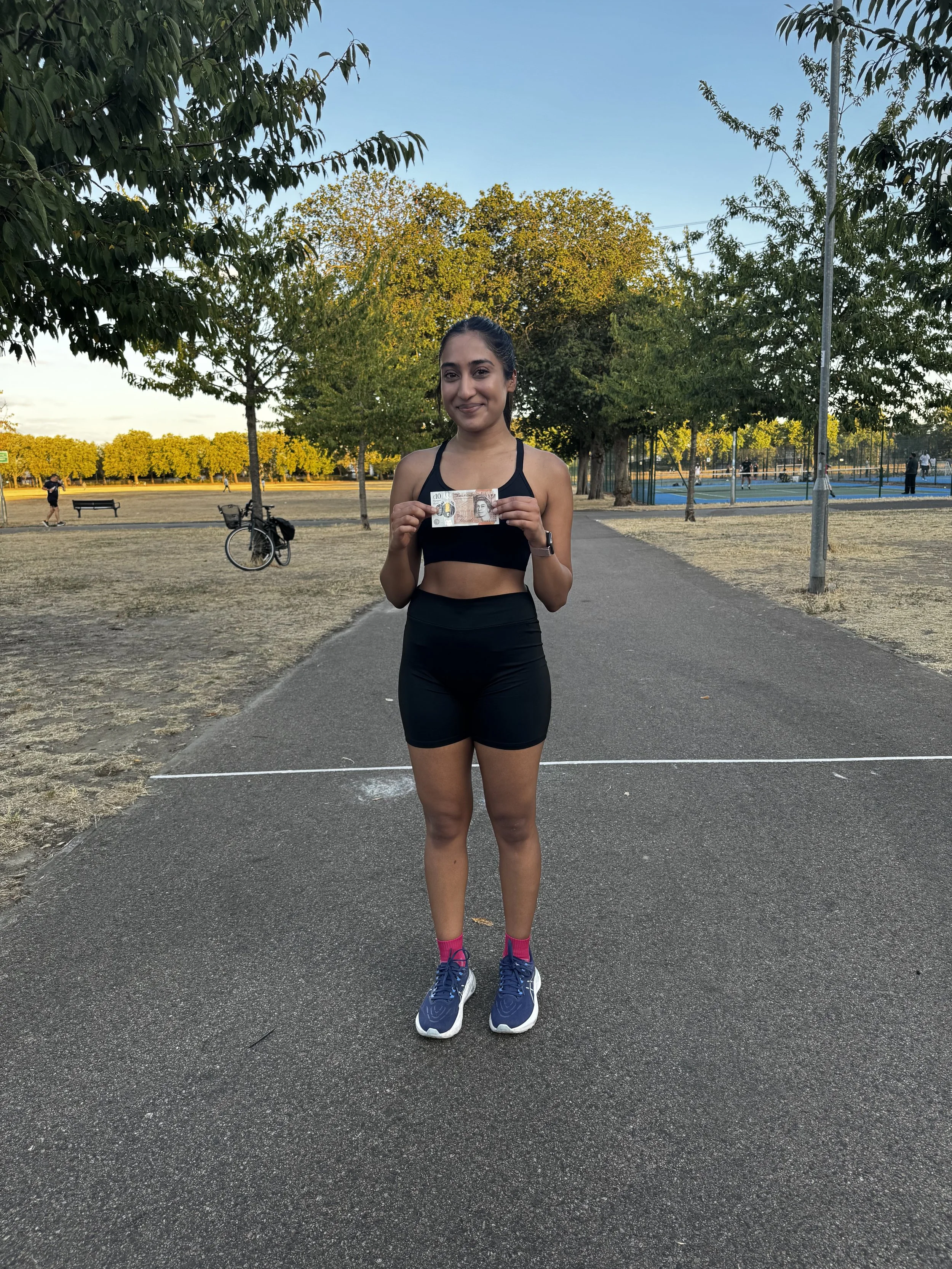
Tia with her prize money
Hiya Road Runners
No club races this week, but that doesn’t mean folks were sitting raound doing nothing, despite the continuing hot weather. Well done to thos who went out and races. Others completed a variety of training runs, cycles, and swims. Some of us visited Eastbrookend Country Park, where we are organising a Chingford League race at the end of October. The course was as dry as a bone - unrecognisable from when we ran the Dagenham 88 ELVIS race there in May. I’m hoping we get a lot of rain in the lead up to October, to make the terrain more ‘interesting!’
But, before then, we have the August Bank Holiday race to think about. Thank you to everyone who has been able to commit to the race - either running or volunteering so far. It’s not to late to step forward!
Greg’s Race Round-Up
Barking Road Runners Summer Handicap Series Race No. 5 this week was won by Tia Sindall with Astrid Effendi in 2nd place and Joyce Golder 3rd. Of the 19 runners competing eight runners managed to dip inside their HC time and will face a sterner test in Race No. 6.
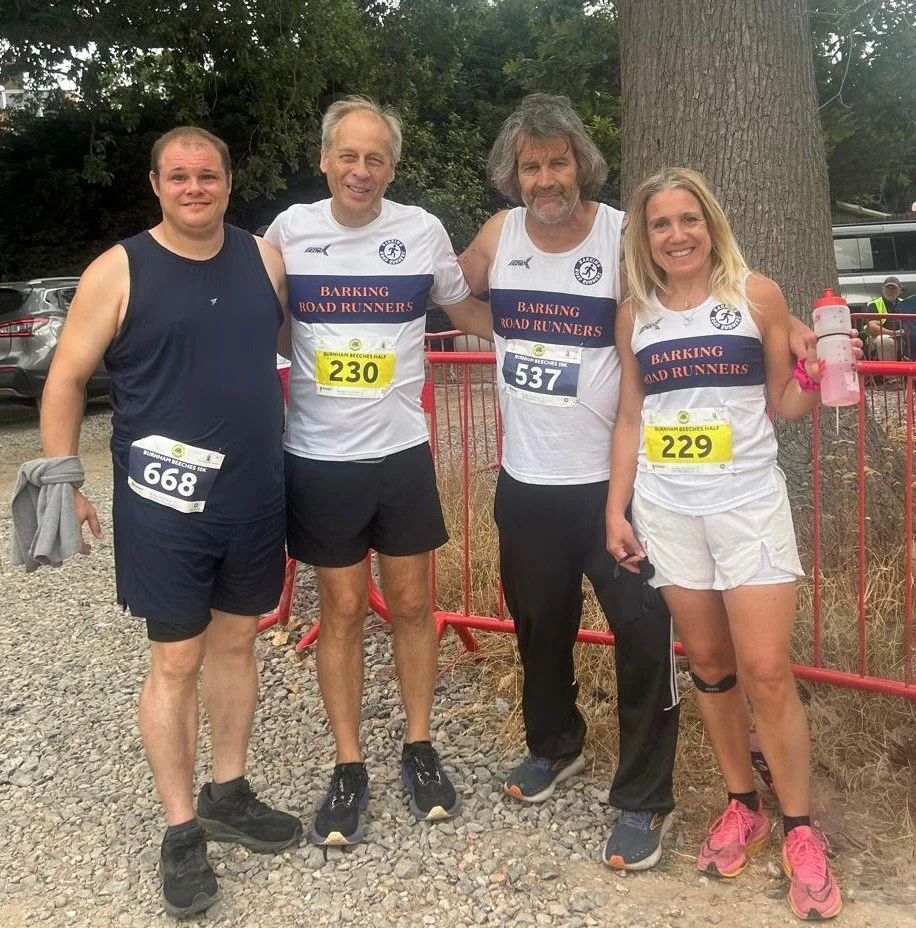
Darren, Barry, Steve, and Belinda at the Burnham Beeches races
Several BRR runners competed in the Burnham Beeches races this week in either the Half Marathon or 10k events. Belinda Riches 1:57:28 and Barry Rowell 2:29:56 ran the Half Marathon whist Steve Colloff 1:10:58 and Darren Graham 1:24:58 ran the 10k race.
Alison Fryatt, Dawn Curtis, and Chris Anastasi went for something a little different at the weekend entering the Chigwell and Epping Forest orienteering clubs 60th anniversary sprint races. There were two races a 1.2k race in the morning and a 1.3k race in the afternoon. Alison was the first BRR member overall followed by Dawn and Chris.
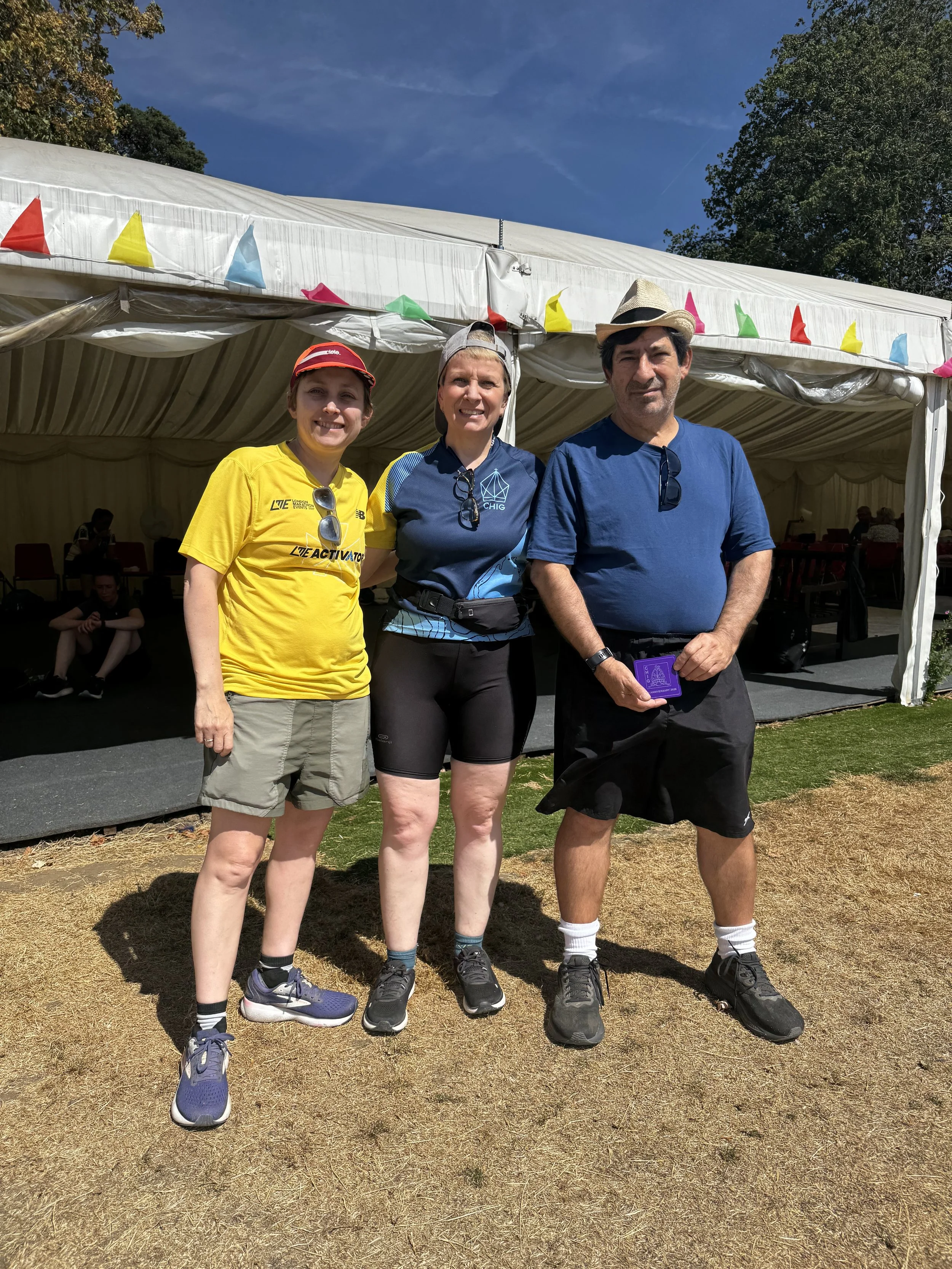
Dawn, Alison and Chris at the CHIG 60th anniversary sprints
BRR parkrunners
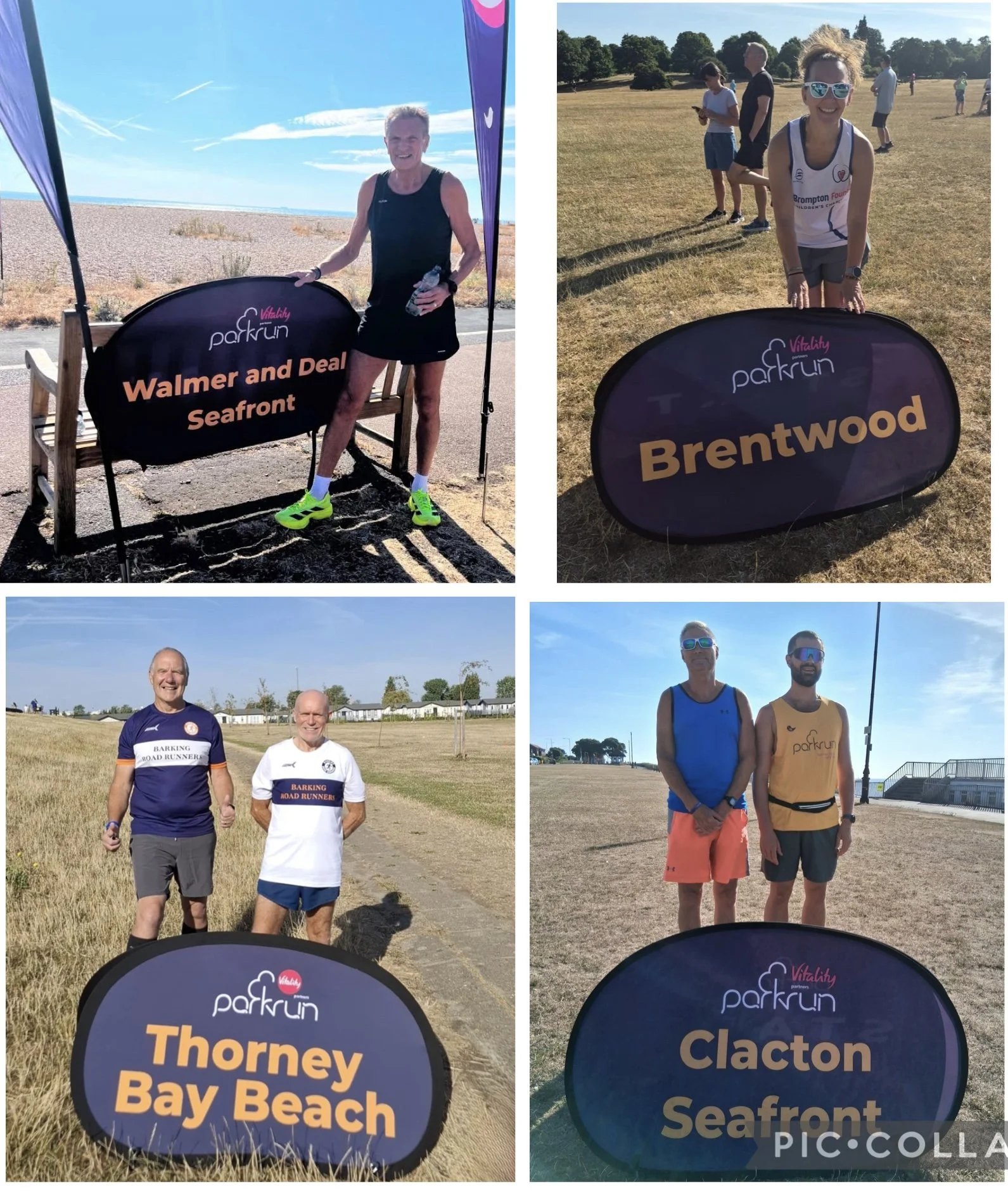
Some of our BRR parkrunners this week
Ashbourne Recreation Ground - Stuart Mackay 20:19 and Jess Collett 22:52.
Barking - Joshua Ezissi 21:42, Owen Wainhouse 22:07, Shantelle Keech 23:47, Jack Stanford 24:01, Jason Suddaby 25:45, Paul Manson 27:54, Barry Rowell 28:33, Jason Li 29:56, Sian Mansley 32:13, Dennis Spencer Perkins 34:35, Emma Paisley 34:39, James Hall 34:41, Martin Mason 36:39, Astrid Effendi 28:21, Nikki Cranmer 38:34 and Alan Murphy 50:13.
Bournemouth - Mark New 25:25.
Brentwood - Louise Chappell 43:53.
Clacton Seafront - Rory Burr 22:05 and Stuart Burr 28:15.
Gunpowder - Paul Ward 23:38.
Raphaels Park - Doug King 29:12.
Roding Valley - Paul Withyman 21:11.
Thorney Bay Beach - Ron Vialls 24:02 and Gary Harford 29:34.
Valentines - Kevin Wotton 26:11, Martin O’toole 30:10 and Andrew Gwilliam 50:39.
Walker and Deal Seafront - Martin Page 22:08.
Wimpole Estate - Martin Brooks 27:40.
Highest BRR age Gradings this week were Jess Collett 68.29% for the women and Martin Page 78.77% for the men.
BRR Diary - August
The highlights of the coming weeks are listed below but you can see the full diary of BRR events on the TeamUp app. Just download the TeamUp app to your phone, then enter the calendar key: ks67p21gt8p5gzdo66 when prompted. If you don’t want another app on your phone, you can also find it under the ‘events’ tab on the Barking Road Runnerswebsite: https://www.barkingroadrunners.org.uk/calendar.
7.00pm, Tuesday 11 August - Speed Work. Jim Peter’s Stadium, Mayesbrook Park. This week, we have a fartlek session which I am calling ‘the dice session’:
How it works
The session is divided into 10 rounds of 3 minutes. At the start of each round, I roll the dice. The number rolled tells everyone how long they must run hard (i.e. 5-10k effort, working hard but controlled, holding form).
🎲1 - 30 seconds
🎲2 - 1 minute
🎲3 - 1 min 30 secs
🎲4 - 2 minutes
🎲5 - 2 min 30 secs
🎲6 - 3 minutes
The rest of the three-minute block is easy jogging recovery. For example, roll a four and you run hard for two minutes and jog easy or walk for one minute. If you roll a six, you run for three minutes and there is no recovery. Apparently there is only a 1-in-36 chance of that happening. The odds of three 6s in a row is just 1-in-216. I might be kind and give you some extra recovery if that happens.
7.30pm, Wednesday 12 August - Crown to Crown 5k. Westley Heights Country Park (at the rear of the Miller & Carter – Crown Public House), High Road, Laindon, Essex. A nice, no-nonsense, mainly off-road 5k. Enter in advance or on the night. Pitsea RC 5k Crown to Crown - August - EntryCentral
7.00pm, Thursday 13 August - Summer Handicap #06. Barking Park, parkrun course. £1 to enter and the chance to win a tenner.
7.00pm, Thursday 20 August - Summer Handicap #07. As above.
7.00pm, Thursday 27 August - Summer Handicap #08. Last race in the competition!
10.30am, Monday 31 August - Phipps (August Bank Holiday) 5k (ELVIS 08). Barking Park. Our very own ELVIS race. Hopefully you are either running or volunteering on the day. Remember, BRR runners get half price entry - ask for the discount code before entering.
Bargain Basement Bonus?

50,000 dollars? I wouldn’t say no!
Josh Kerr received a $50,000 bonus for breaking the mile world record a little while ago. That’s equivalent to around £37,000. Sounds good until you realise that the bonus is exactly the same as received by Hicham El Guerrouj when he set the previous mile world record nearly 27 years ago.
Speaking after the race, Kerr described the situation as "appalling". Looking at the numbers, he may have a point. If that £37,000 had kept pace with inflation since 1999, it would be worth around £74,000 today. In real terms, the value of the reward has halved.
Of course, there is another way of looking at it. World records bring prestige, sponsorship opportunities and a place in sporting history that no amount of money can buy. Some would argue that athletes should be motivated by the achievement itself rather than the cheque that comes with it.
What do you think? Should Kerr simply be delighted to have broken one of athletics' most iconic records, or is he right to expect a financial reward that reflects the scale of the achievement and keeps pace with inflation?
Running Faster
According to Alex Cyr from Marathon Handbook, first and foremost, you need health and motivation to run well and get faster. But, once those foundations are in place, these are his top five tips for runners of all levels:
1. Learn how hard to run. On easy days — which should be most of the time — keep the effort genuinely easy. On hard days, such as race days or tougher training sessions, run hard. Easy should feel like around 5/10 effort, or a comfortable conversation pace; hard should feel closer to 7/10. Trying to run every session hard increases the risk of injury and will quickly tire you out.
2. Prioritise sleep. Aim for a consistent sleep routine whenever you can, with around eight hours as the ideal. And if alcohol affects your sleep, it may be worth cutting back.
3. Make the most of the hour after your run. Don’t just collapse on the sofa. Use that important recovery window to rehydrate, refuel with protein and carbohydrates, and replace electrolytes. Supplements such as protein powder or creatine may help, but getting the basics right matters most.
4. Get the right shoes. Running shoe technology has moved on, so it is worth checking whether your trusty old favourites are still doing the job. Cyr recommends having a daily trainer, a super shoe and — if budget allows — a super trainer, which sits somewhere between the two. Modern shoes can be expensive, but they are often more durable and usually need little breaking in.
5. Enjoy what you do. Keep running fun by trying different types of running — track, trail and road — as well as different distances. Don’t pigeon-hole yourself. You might discover that something you once avoided is now exactly what you enjoy, or that a particular race distance hits the sweet spot.
Do you agree with Cyr? I’d love to hear your own “go faster” tips.
Running Through History: Hainault Forest
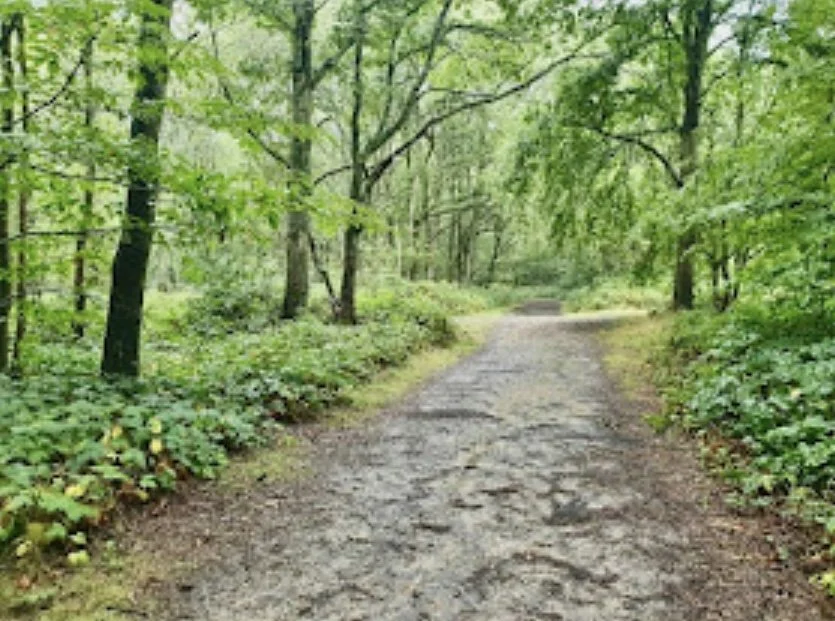
Hainault Forest
Many of us know Hainault Forest from our Sunday morning trail runs, or maybe the Newman Hilly 5, but few realise they're running through more than 900 years of history.
Hainault was originally part of the Forest of Essex, a royal hunting forest used by Norman and medieval kings. In those days, a forest was much more than woodland – it was a landscape governed by forest law, where deer were protected for royal hunts and local people had tightly controlled rights. Following the Charter of the Forest in 1225, communities were allowed to graze livestock and manage trees, practices that helped shape the woodland we see today.
By the mid-19th century, Hainault Forest covered more than 4,000 acres. However, in 1851 an Act of Parliament removed its protection and the destruction was swift. Around 100,000 trees were felled in a matter of weeks and steam-powered ploughs ripped up vast areas of ancient woodland to create farmland. Sadly, more than 90% of the forest was lost.
Public outrage at the devastation helped inspire Britain's early conservation movement, and campaigners led by Edward North Buxton eventually secured protection for part of the surviving forest.
So next time you're out on the trails at Hainault, remember: you're not just running through a country park, but through a landscape shaped by medieval grazing, royal hunting and one of the most significant conservation battles in British history.
Cracker Corner
What do you call a Mexican who has lost his car? Carlos
What do you call a man lying in a pile of leaves?
Russell.
What do you call a man floating in the ocean?
Bob.
Quote of the week
“I became a great runner because if you're a kid in Leeds and your name is Sebastian, you've got to become a great runner.”
Sebastian Coe
And Finally…
Sorry, one last mention of Josh Kerr (for now). The men's mile world record breaker has already set his sights on a very different challenge. Kerr recently admitted he is "obsessed with the [London] marathon" and hopes to tackle the iconic 26.2-mile distance before his career ends.
Kerr is currently one of the world's finest middle-distance runners, specialising in explosive speed, tactical racing and a devastating finishing kick. The marathon, however, demands a completely different skill set: endurance, patience and the ability to maintain a relentless pace for around two hours.
History offers both encouragement and caution. Olympic champion Sifan Hassan successfully transitioned from track racing to marathon success, famously winning the London Marathon on her debut before going on to Olympic gold. On the other hand, Sir Mo Farah found the transition more challenging, taking several years to become fully competitive over the distance and perhaps never reaching the standard that he might have hoped.
Kerr himself describes the goal as a "pipe dream" and stresses that he still has unfinished business on the track. Yet his willingness to think beyond his comfort zone is a reminder that great athletes are always looking for the next challenge. Proof - if needed - that I am not a great athlete…