BRR Blog - 15 December 2025
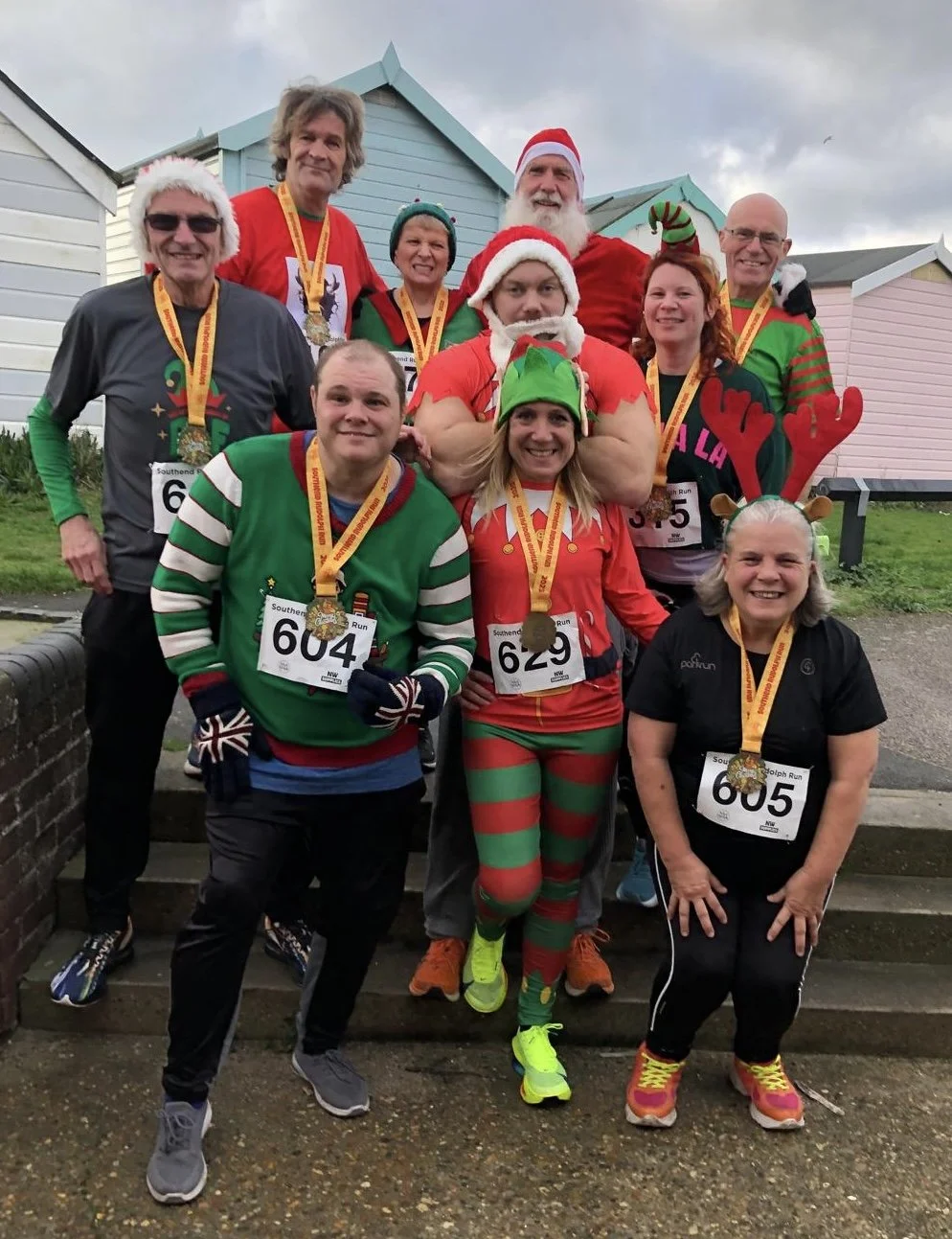
The BRR team at the Rudolph Run. Not sure why I am pulling that face.
Hello Road Runners
The news in the week that the Richard House shop in Barking had closed down was a bit of a shock; a lot of us have dropped donations there, or popped in after parkrun to look for some bargains while giving money to a good cause. But the news later in the week that the Richard House Hospice itself was closing down was a real shocker. Barking Road Runners has raised lots of funds for the hospice over the years as, I’m sure, lots of others have. But it seems rising costs and inflation were just too much. We can only hope the 300 plus children they have been caring for can get the help they need somewhere else.
In better news, there was a lot of racing over the past week and and some great performances. All the details in Greg’s Race Report.
Heart Rate Variability (HRV)
Here’s the latest in the occasional series ‘what on earth does that statistic on my running watch actually mean?’ and this time it is about Heart Rate Variability or HRV.
HRV refers to the variation in time intervals between consecutive heartbeats, measured in milliseconds. A healthy heart shows slight fluctuations between beats. This variability reflects the balance between the sympathetic nervous system (fight-or-flight) and the parasympathetic nervous system (rest-and-digest). For runners, HRV is a powerful indicator of training readiness, recovery status, and overall resilience.
What is a Good HRV?
A higher HRV generally suggests that your body is well-rested, adaptable, and ready for physical stress, while a lower HRV can indicate fatigue, overtraining, or stress.
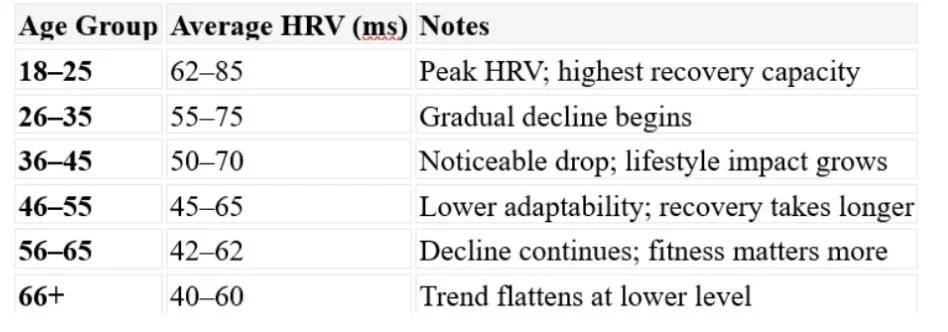
But there is no universal “ideal” HRV because it varies significantly by age, genetics, fitness level, and lifestyle. However, for most healthy adults, an HRV between 60–100 ms (milliseconds) is considered good, with elite athletes often recording higher values. The key is to track your personal baseline rather than comparing to others. Consistently high HRV readings relative to your baseline indicate strong recovery and readiness for intense training. Conversely, a sustained drop below your norm may signal the need for rest or lighter workouts.
Here’s a summary table of average HRV ranges by age and fitness level:
Measuring HRV:
Measure HRV under consistent conditions, ideally in the morning before getting out of bed.
Use trends over time rather than single readings to guide training decisions.
Factors like sleep quality, hydration, stress, and nutrition strongly influence HRV.
Tips to improve HRV:
1. Improve your sleep by maintaining a regular schedule, avoiding screens before bed, and practising good sleep hygiene.
2. Incorporate daily breathwork, such as slow diaphragmatic breathing, to activate your parasympathetic nervous system.
3. Take regular exercise, including both aerobic and strength training.
4. Avoid overtraining and ensure adequate recovery, to reduce stress on the body.
5. Spend time outdoors, especially in nature.
6. Practice yoga and meditation techniques.
7. Stay well-hydrated, as dehydration stresses the body.
8. Limit alcohol consumption, as excessive drinking can impact HRV for several days.
9. Eat more leafy green vegetables, such as spinach and kale.
10. Reduce your commute or finding better work-life balance (if only…).
A-Z of Running
Episode eighteen in the A-Z of running, and this week it is brought to you by the letter ‘R.’
🏃 Race Pace - The speed you aim to maintain during a race e.g. 5k race pace, marathon race pace etc. You should practice race pace in training to build confidence and efficiency. This is why we often ask you to train at race pace at track.
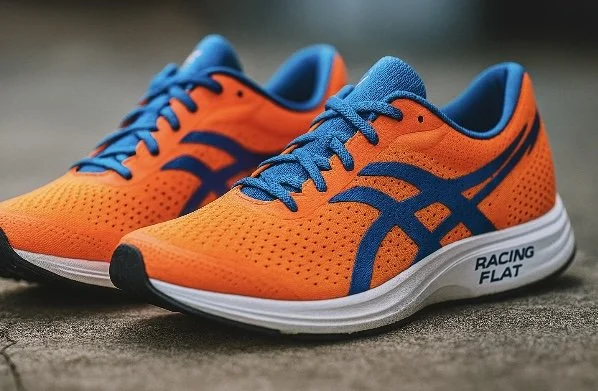
🏃 Racing Flats - Lightweight shoes designed for speed and racing. They should be used for short races or speed sessions, not for everyday training. They are often not very comfortable as they lack cushioning.
🏃 Recovery Run - A short, easy-paced run designed to aid muscle recovery after hard workouts. You should keep the pace conversational (i.e. you have enough breath to talk in full sentences). It should feel effortless – if it isn’t you are running too hard.
🏃 Repeats - Short, fast intervals run multiple times with recovery periods in between. Repeats are great for speed development. They also make a running session more fun than just slogging it out at the same speed mile after mile.
🏃 Resistance Training – involves strength exercises using weights or bodyweight, to improve muscle endurance and power. Including squats, lunges, and core work twice a week will help to prevent injuries.
🏃 Rest Day - A day without running to allow muscles to recover and adapt. Rest days are essential for avoiding overtraining and should be regarding as a vital part of your training plans. Rest doesn’t mean doing nothing; you can use active recovery like walking or yoga if desired, but shouldn’t feel guilty about complete rest if your body is telling you it needs it.
🏃 Route Planning - Mapping out your running course in advance, usually using apps like Strava, Mapometer, or MapMyRun. Just be aware that apps don’t always give you the full information about a route.
🏃 Rolling Hills - Terrain with frequent ups and downs, the opposite of ‘flat as a pancake’. Hills help to build strength and stamina. Remember to maintain effort rather than pace on hills.
🏃 Run-Walk Method - Alternating running and walking intervals during a workout e.g. run 5 min, walk 1 min. Also known as jeffing, after its inventor, Jeff Galloway. The method is ideal for beginners but also for long-distance training, where it can lead to better times and less impact on the body than running flat out.
🏃 Runner’s High - euphoric feeling during or after a run caused by endorphin release. Most likely to occur during longer runs. It happened to me…once.
Greg’s Race Report
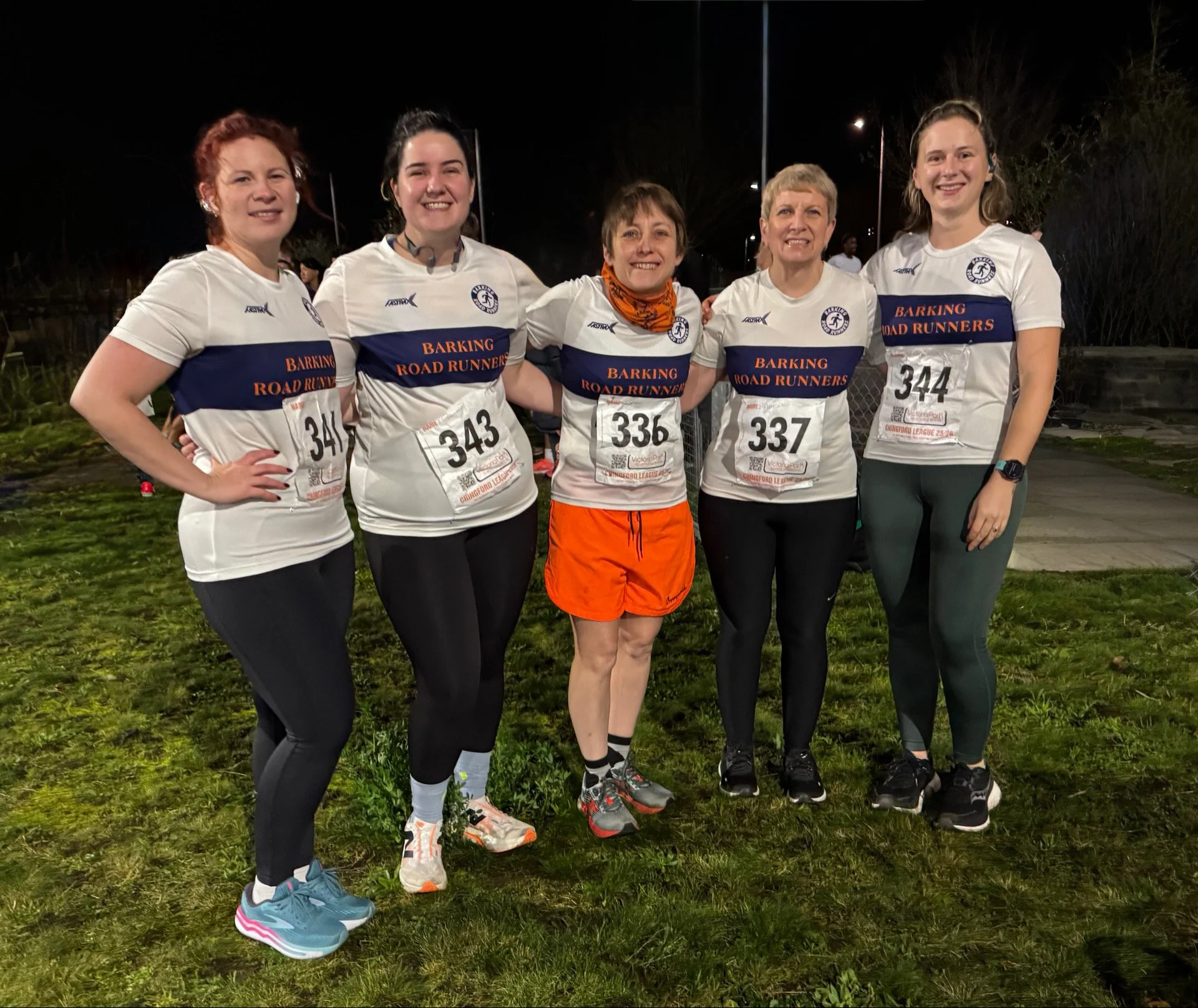
The BRR women’s team at the Chingford League
Round 4 of the Chingford League took place with the second race of the season on the outdoor cycle track at the Velodrome in the Olympic Park. First across the line for the BRR women was Emma Paisley 29:35 followed by Clodagh Shorey 30:44, Sian Mansley 30:51, Alison Fryatt 34:14 and Dawn Curtis 34:53. The men’s results aren’t available at the time of going to press but running for BRR were Stuart Mackay, Martin Page, Jason Suddaby, Daniel Plawiak, Mark New, Chandru Thayalan, John Lang, Rob Courtier, Barry Rowell, Gary Harford, and Darren Graham.
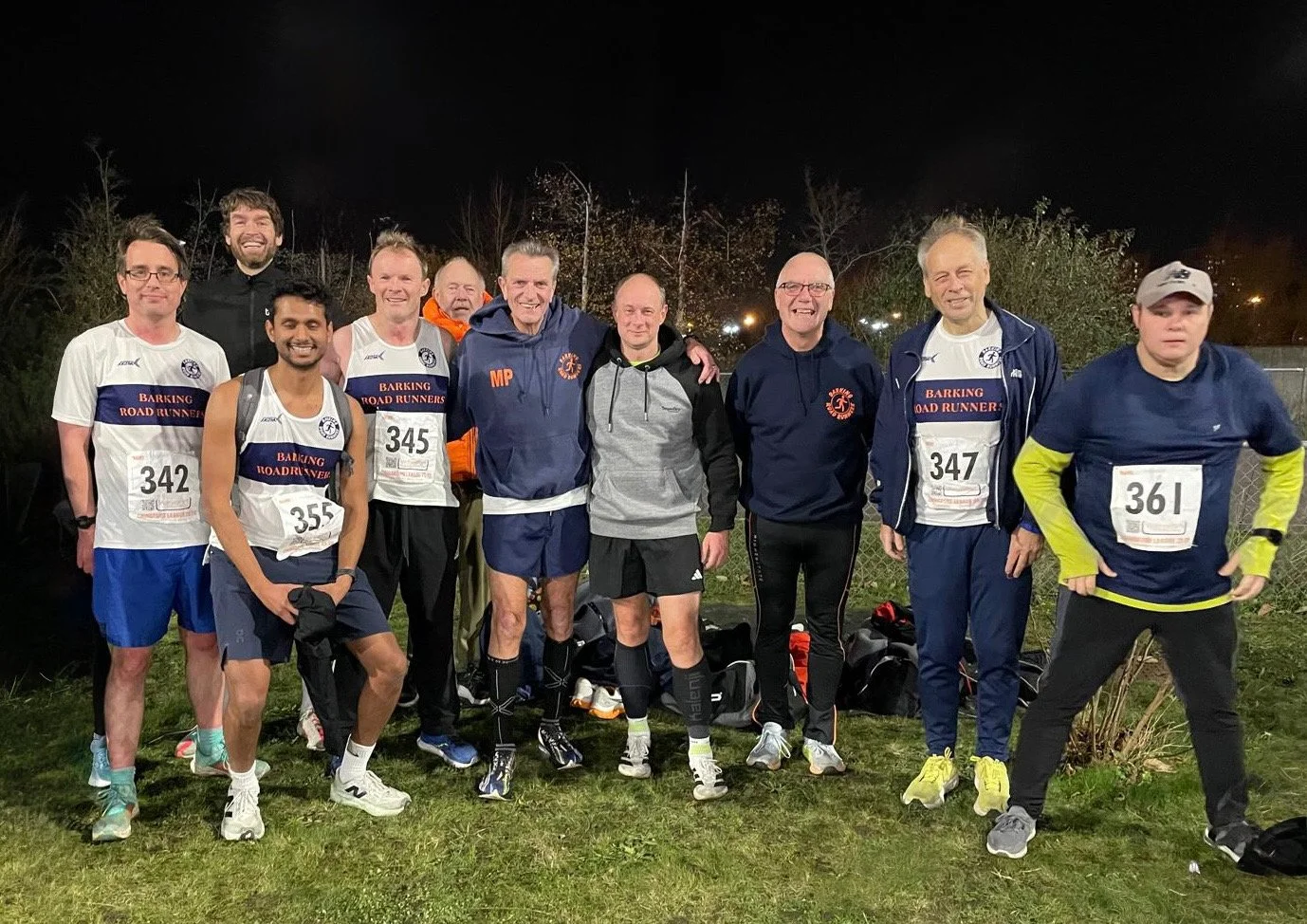
Most of the BRR men’s team at the Chingford League
On Saturday Jason Suddaby ran in the Victoria Park 10k finishing in a time of 46:15.
Several Barking Road Runners took part in the festive 5-mile Rudolph Run along the seafront at Shoebury and Southend on Sunday. First finisher was Martin Page 36:56 followed by Ron Vialls 40:35, Belinda Riches 45:40, Steve Colloff 51:18, Sian Mansley 53:37, Alison Fryatt 59:07, Dennis Spencer Perkins 1.00.26, Darren Graham 1:23:32 and Denise Graham 1:24:13.
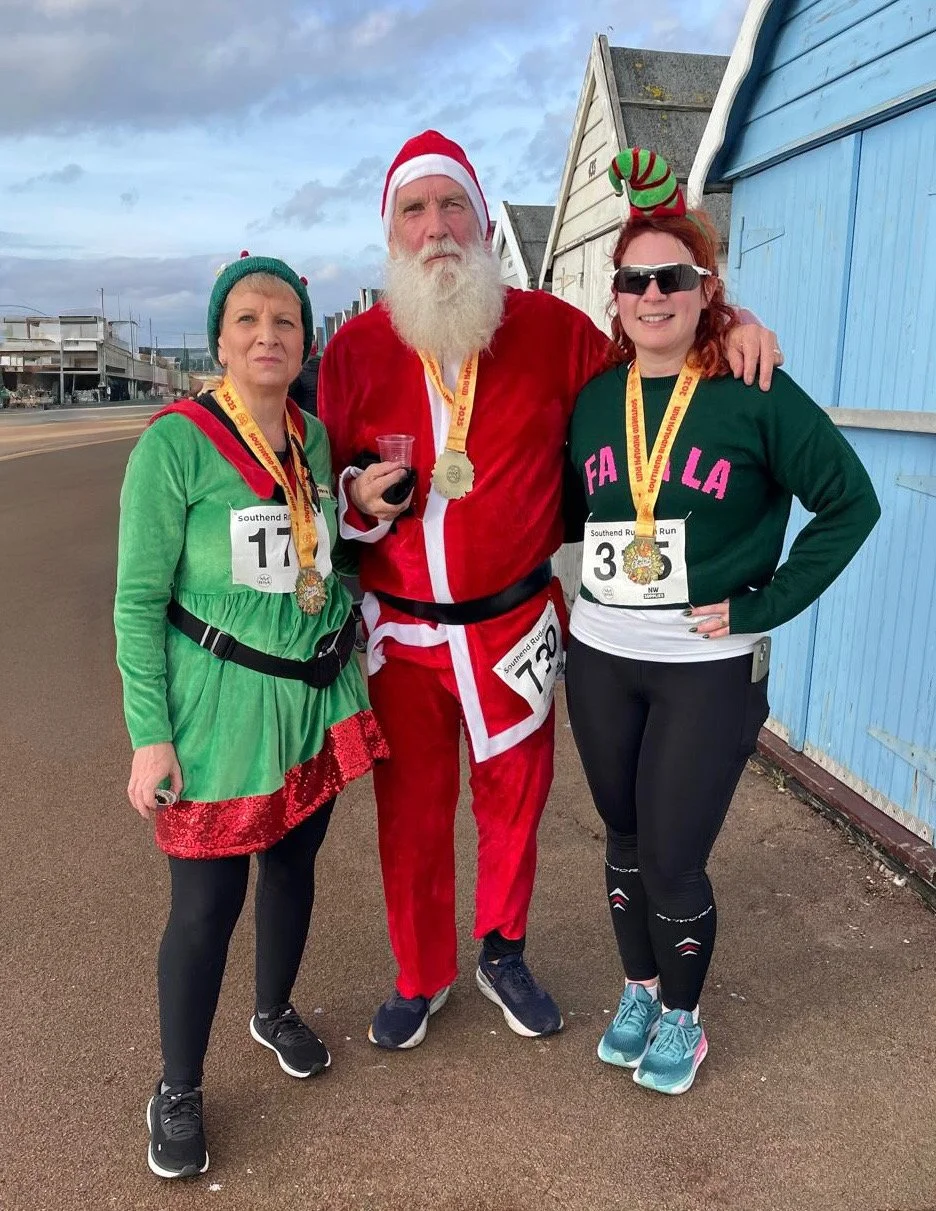
Santa, and two elves
BRR Parkrunners
ABU Writtle - Gary Harford 27:40 and Louise Chappell 28:59.
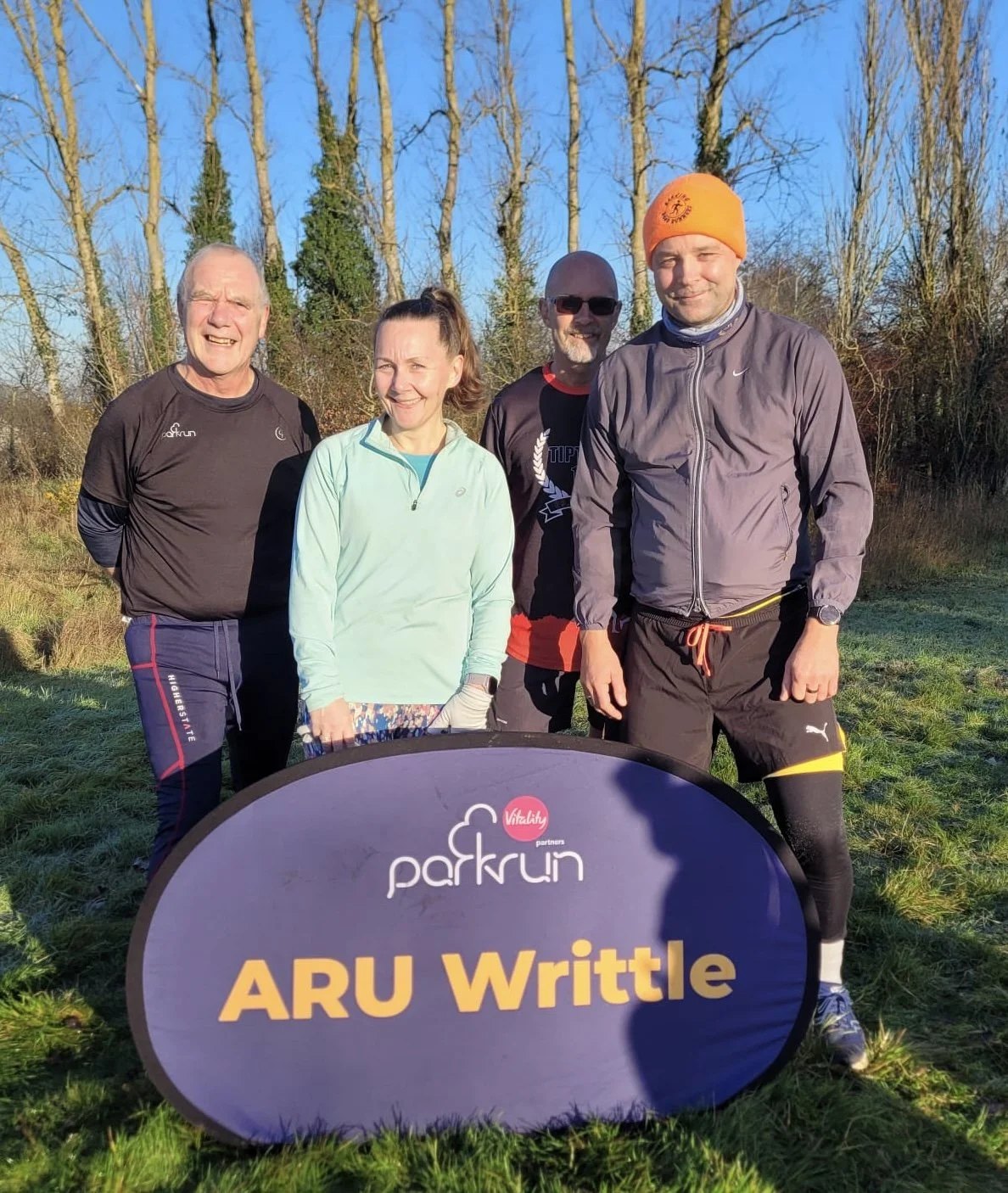
Gary, Louise and Craig at ARU Writtle parkrun, with that dodgy bloke from D88
Barking - Mark New 25:17, Chris Muthaka 27:21, Jason Li 29:06, Dawn Curtis 32:43, Martin Mason 32:47, Belinda Riches 35:29, Darren Graham 51:17, Alan Murphy 51:57 and Denise Graham 75:34.
Brook Leys - Sunny Bulchandani 25:13.
East End New Plymouth, NZ - Joyce Golder 29:51.
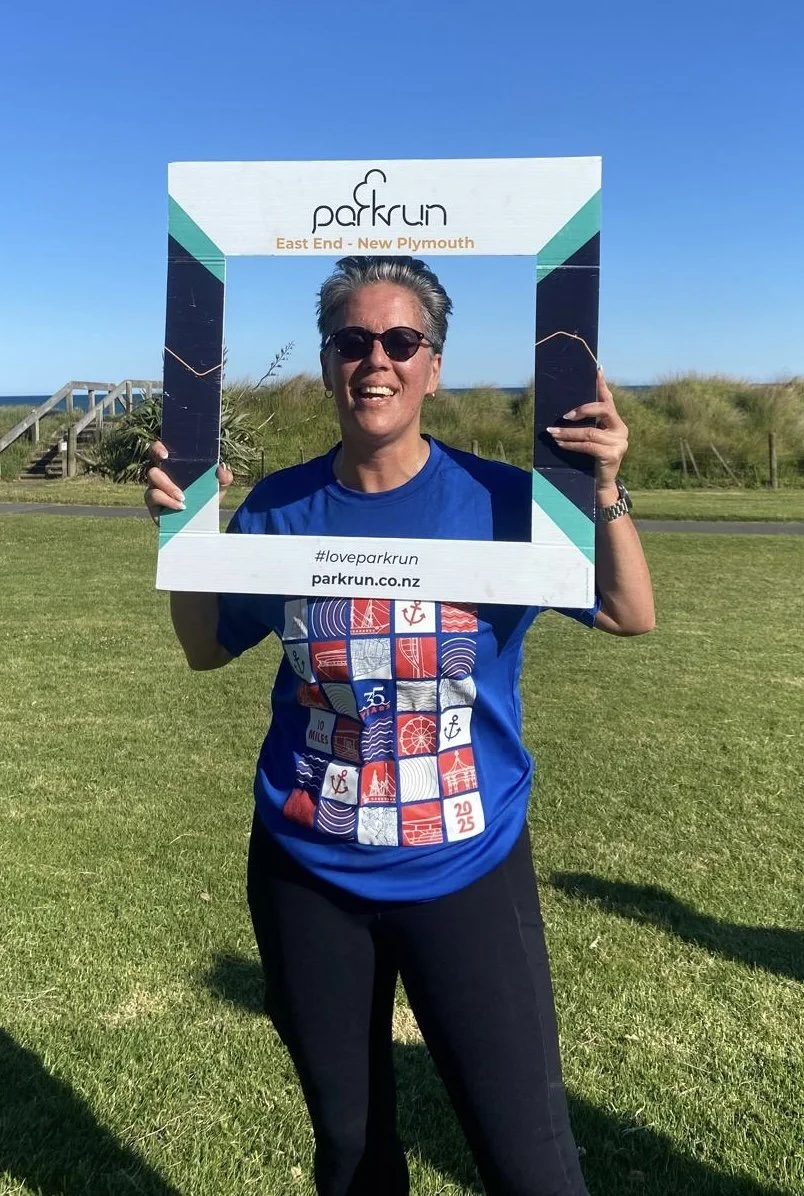
Joyce at East End-New Plymouth parkrun
Finsbury Park - John Mitchell 34:42.
Harrow Lodge - Rory Burr 23:37.
Hillsborough - Rosie Fforde 24:06.
South Norwood - Nikki Cranmer 29:45 and Rob Courtier 35:21.
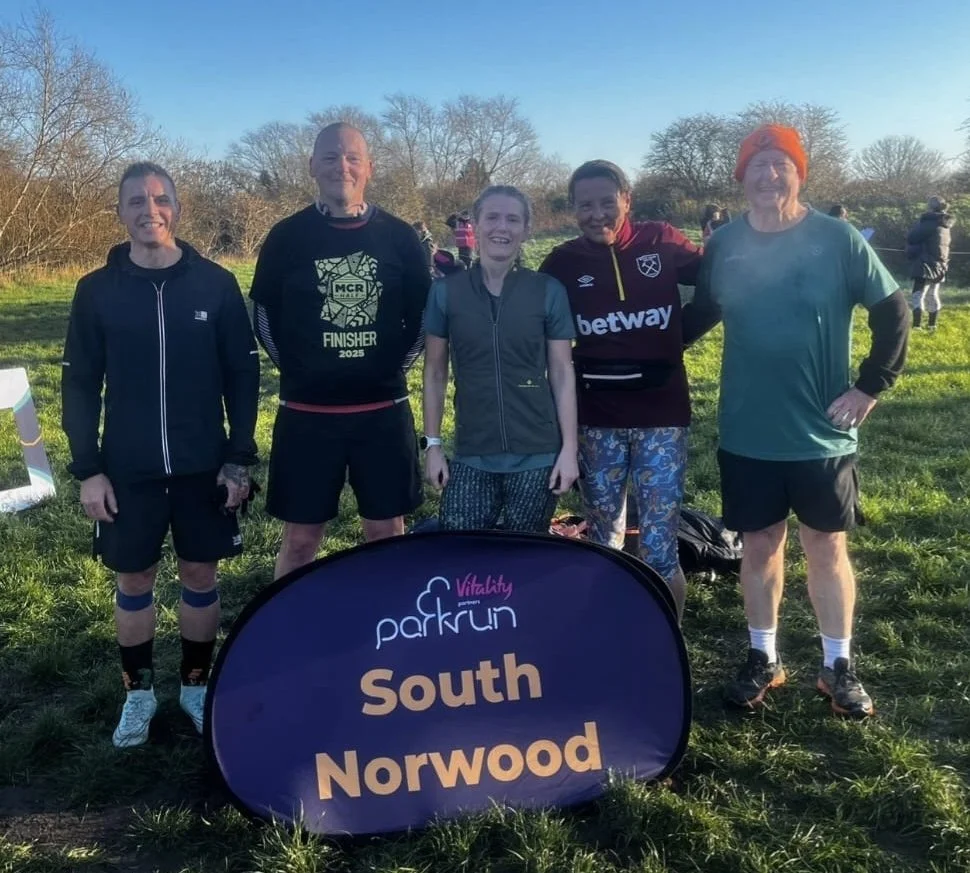
Nikki, Rob and others at South Norwood
Valentines - Kevin Wotton 24:40 and Richard Dudman 27:48.
Wanstead Flats - Stuart Mackay 20:18.
Wimpole Estate - Martin Brooks 27:49.
The highest age gradings were Rosie Fforde 62.45% for the women and Stuart Mackay 72.09 for the men.
BRR Diary - December
Please note: We are awaiting an announcement as to whether parkrun will be going ahead on New Year’s Day at Valentines Park.
The highlights of the coming weeks are listed below but you can see the full diary of BRR events on the TeamUp app. Simply download the TeamUp app to your phone, then enter the calendar key: ks67p21gt8p5gzdo66 when prompted. If you don’t want another app on your phone, you can also find it under the ‘events’ tab on the Barking Road Runners website: https://www.barkingroadrunners.org.uk/calendar.
7.00pm, Tuesday 16 December - speed session. Jim Peters Stadium, Mayesbrook Park. This week Zahra will be taking the - very festive - Christmas Tree session (RPE is rate of perceived effort, in case you’ve forgotten):
5 mins at 2 rpe, 1 min recovery
4 mins at 4 rpe, 1 min recovery
3 min at 6 rpe, 1 min recovery
2 min at 8 rpe, 1 min recovery
1 min at 10 rpe, 1 min recovery (top of the tree)
2 min at 8 rpe, 1 min recovery
3 min at 6 rpe, 1 min recovery
4 mins at 4 rpe, 1 min recovery
5 mins at 2 rpe, 1 min recovery
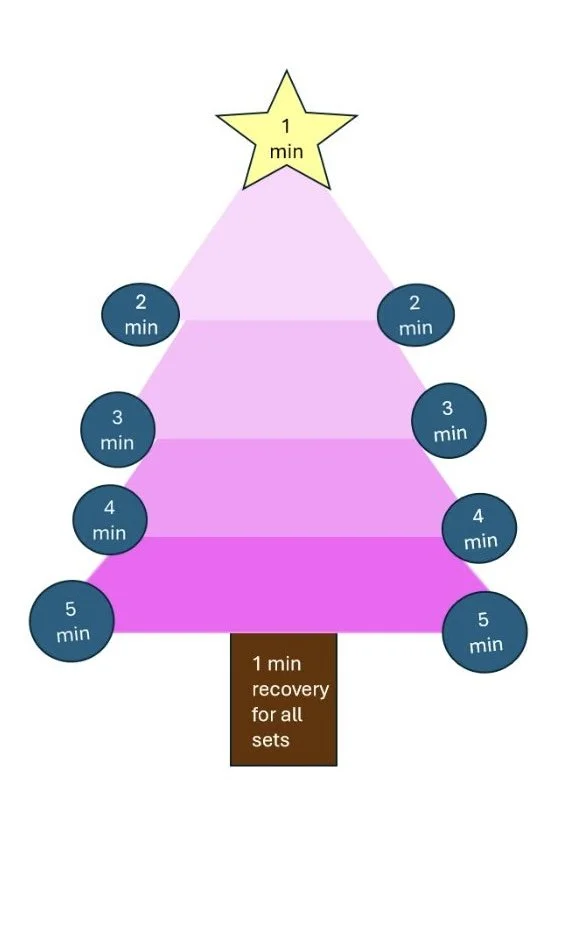
The Christmas Tree session
7.00pm, Thursday 18 December - Club road run. Castle Green Centre, Gale Street, Dagenham. A social run around the pavements of Barking and Dagenham, just over four miles long. Following the festive theme, we will be doing the Sweetie Run, which is just over four miles (faster runners can loop back to add distance):
Left out of Castle Green along Gale St > Right Arden Cres > Right Hedgemans Rd > Left Heathway > Left Parsloes Avenue > Left Spurling Rd > Right Ivyhouse Rd > Across to Rugby Rd > Left Lodge Ave > Right Woodward Rd > Right Arden Cres > Right Gale St > back to Castle Green. And rest!
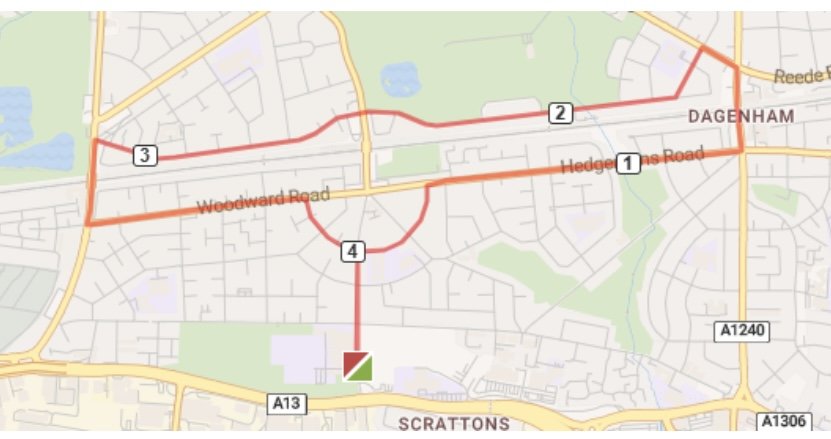
Thursday’s night’s planned run
9.30am, Sunday 21 December - Christmas Royal Parks Run. Meeting at Barking Bus Garage at 8.30am or Matthew Parker Street (nearest tube St. James’s Park), Westminster at 9.30am. Our annual run through St. James’s Park, Green Park, Hyde Park and Kensington Gardens, about 10k, followed by lunch in the cafe in St. James’s Park, for anyone who fancies it.
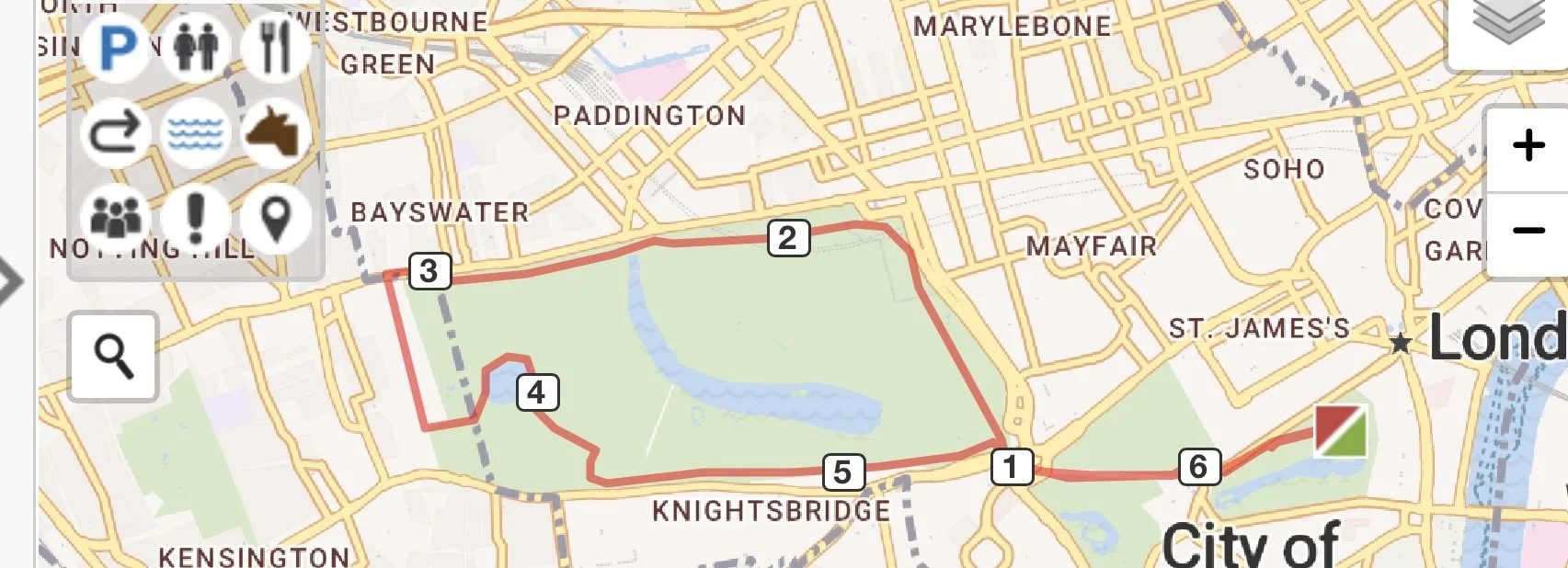
The approximate winter parks route
7.00pm, Tuesday 23 December - speed session. Jim Peters Stadium, Mayesbrook Park. The last session before Christmas, and it will be crackers! In other words, random 12 minute rep sets, with maybe some strength work thrown in!
9.00am, Thursday 25 December - Barking parkrun.
11.00am, Friday 26 December - Boxing Day Crown to Crown. Westley Heights Country Park, 1 Dry St, Langdon Hills, Basildon SS16 5LT. A measured 5k undulating part-trail and part-road route, which is challenging in parts, yet equally picturesque. Just £2.50 (£4.50 non-EA) to enter on the day, or you can sign up in advance to avoid the queues: https://www.entrycentral.com/Crown-to-Crown.
10.00am, Sunday 28 December - South Essex Cross Country League 03. Hadleigh Country Park, Chapel Road, Hadleigh. It’s the one with the water features! Make sure your shoes are laced up tight or you might lose them. And definitely bring a change of clothes for afterwards. As usual, £3 for BRR members, paid into the bank account or cash on the day.
Cracker Corner
Did you hear about Santa’s elf who decided to go into the music industry? He’s working as a rapper.
Do you know which athlete is warmest in winter? A long jumper.
I think the best Christmas present is a broken drum. You can’t beat it.
Quote of the Week
“Great things are done by a series of small things brought together.”
Vincent Van Gogh
Van Gogh was probably talking about painting, but I thought this quote equally applied to running: it’s not the one, big, run that counts, its being consistent across all the smaller elements of your training plan.
And finally…
Guinea pigs wanted. The latest edition of Runner’s World magazine lists five things to eat or drink to avoid muscle cramps during a run, and some are more palatable than others. Tart cherry juice is probably the tastiest (though quite expensive to use on a regular basis) but it goes downhill from there: pickle juice, hot sauce and mustard. But I’d like someone to volunteer to try banana peel tea. Bananas contain magnesium, potassium and calcium, three of the most effective nutrients for easing muscle cramp. You just need to cut a banana, skin and all, into chunks and boil it in 700ml of water for about eight minutes, then strain and enjoy. Let me know when you have given it a go…