BRR Blog - 19 January 2026
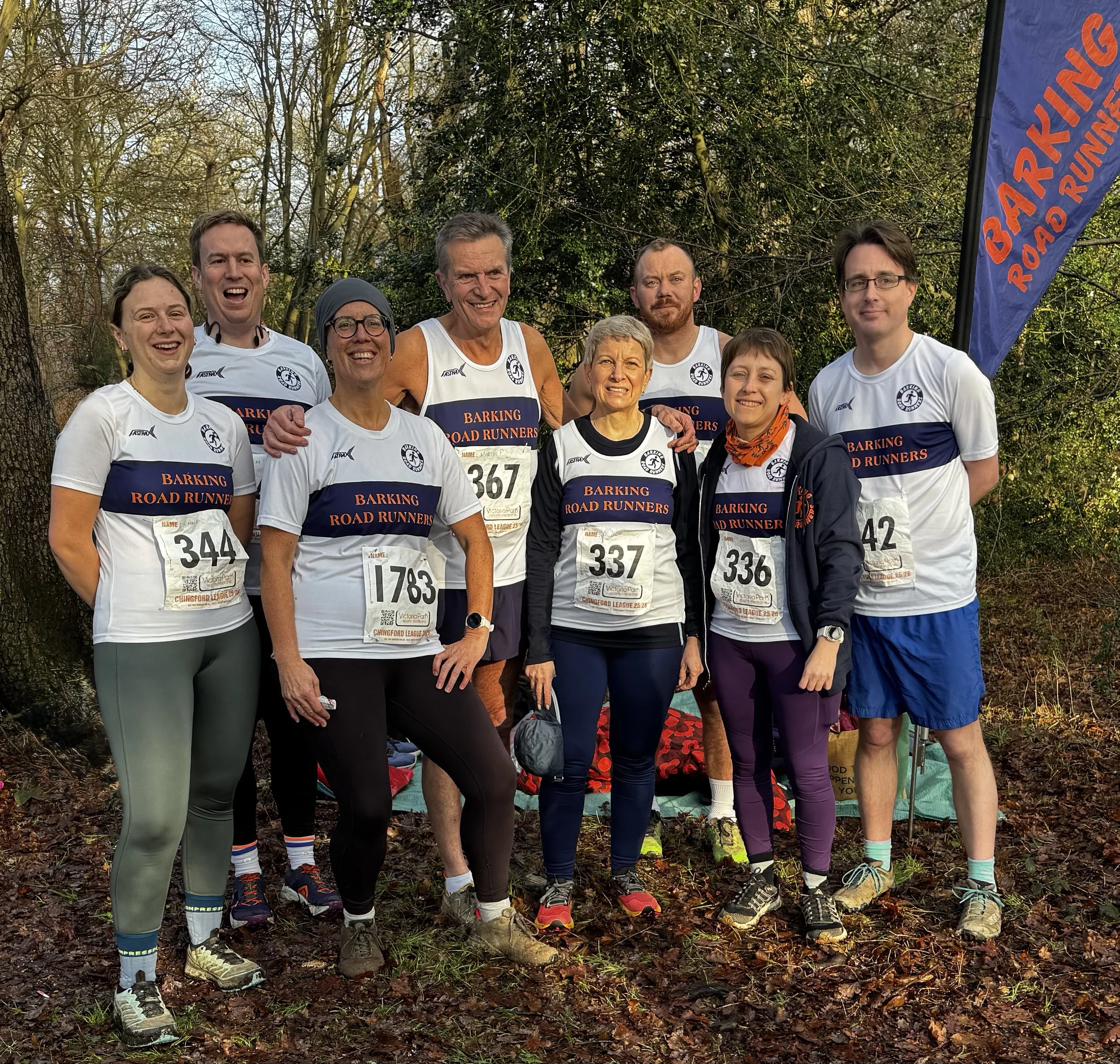
The BRR boys and girls teams at the Epping Forest Chingford League race
Howdie, Road Runners
It seems to have been a weekend of challenging running experiences, from the Epping Forest Chingford League race on Saturday (239m ascent in five miles - really!) to - everyone’s favourite - the Benfleet 15. All the details in Greg’s Race Report. I’d like to say that next weekend will be easier, but I’m not sure the Nuclear Races cross-country at Kelvedon Hatch can be described as easy! Still, at least most of us will be able to sit back on Sunday afternoon and watch our boys thrashing the builders at football - fingers crossed!
Victoria Docks Vanishes
I was really sad to see the news from Rory last week that Victoria Docks parkrun has closed, after 272 events. The parkrun launched in March 2018 with 83 runners and 11 volunteers but grew over the years to regularly attract more than 200 participants.
But a parkrun needs a solid core of volunteers to be able to carry on. For an event the size of Victoria Dock, or Barking, there are at least seven roles you have to fill each week (the Run Director, finish tokens, 2x timekeepers, 2x barcode scanners, and a tailwalker), and that assumes that people are willing to double up on things like course set-up and take-down. And, that’s without marshals.
If you haven’t volunteered at your local parkrun, why not give it a go? All the roles are really straightforward - if I can do it, so can you! Just volunteering four times a year would be a big help and could make the difference between a parkrun staying alive or closing. Let’s hope Victoria Docks can be resurrected soon.
The Unsung Hero: Ranatunge Karunananda
Some of you may have seen this story on the ‘I am or was a runner’ Facebook page a few weeks ago, but it brought me to tears so I thought I would pass it on.
On 14 October 1964, the Japan National Stadium in Tokyo buzzed with excitement as seventy thousand spectators gathered to watch the men’s 10,000-metre Olympic race. Among the competitors stood Ranatunge Karunananda, representing Ceylon (now Sri Lanka) as their national record holder, despite battling a cold.
At the crack of the starter’s pistol, thirty-eight athletes surged forward. But as the laps unfolded, Karunananda fell further and further behind—eventually lapped four times by the leaders. Nine runners dropped out before the finish, but Karunananda kept going, even as the crowd jeered and officials prepared for the next event. However, as he continued round the track on his own, the crowd’s derision turned first to stunned silence then to admiration. By his final lap, the stadium erupted into a standing ovation, the applause louder than that for the gold medallist.
When asked why he persevered, Karunananda’s reply was simple: he wanted to show his daughter that he ran to the end, honouring the sacrifices of his country and embodying the Olympic spirit—“not to win, but to take part.” While we might have forgotten him, his story became part of Japanese elementary textbooks, inspiring generations.
Karunananda died under mysterious circumstances in 1975, and his family suffered hardship. Decades later, his granddaughter Oshadi arrived in Japan as a student and was shocked to her grandfather’s legacy still alive.
Karunananda’s journey reminds us that finishing—especially against the odds—can echo far beyond the finish line. Sometimes, it’s those who finish last who teach us the most enduring lessons about courage, perseverance, and the true spirit of sport. At least, that is what I am telling myself after coming last at Epping Forest…
A-Z of Running
Episode twenty-three in the A-Z of running, and this week it is brought to you by the letter ‘W’ - wonderful!
Wall (Hitting the Wall) - A sudden drop in energy and performance often caused by depleted glycogen stores during long‑distance running. Many marathoners “hit the wall” around mile 20 if pacing or fuelling is off. It seems to be less common these days, now folks are better at taking on gels or other fuel during races. Most runners deplete muscle glycogen in 90–120 minutes of continuous moderate‑to‑high‑intensity running. The faster you run, the more quickly you will deplete your reserves (Ha! I knew there had to be an advantage to being slower).
Warm‑Up - A period of easy movement and mobility exercises that prepares the body for running by increasing heart rate, muscle temperature, and joint mobility. Example: five minutes of easy jogging, warm-up exercises and strides. Your warm-up should be no more than 15 minutes before your main activity, or the benefits will be lost.
Watchless Run - Also called a naked run, a run completed without looking at (or wearing) a GPS watch to focus on effort and enjoyment instead of metrics. It might be a relaxed weekend run done by feel only, or a race deliberately run without the aid of watches to see how good competitors are at pacing.
Water Station - Designated points on a race course where runners can access water, sports drinks, or other support. Of course, the BRR water station at Mile 15 of the London Marathon is the best in the business.
Wave Start - A staggered race start where runners begin in timed groups (waves) based on predicted finish time to reduce congestion. Common in large-scale races like the London Marathon.
Wear Patterns - The way the tread of a running shoe breaks down over time, which can provide clues about gait, pronation, or stride imbalance. For example, excessive wear on the outer heel may indicate underpronation. Severe wear is a good excuse to invest in some new shoes…
Weather‑Adjusted Pace - A target pace that has been modified based on conditions such as heat, humidity, wind, or cold. Example: Adding 10–20 seconds per mile on very hot days.
Weekly Mileage - The total distance run over a week, often used to structure training progression as you build up to a race.
Wind Chill - The perceived temperature when cold air is combined with wind. Influences clothing choices and can increase risk of cooling too quickly on winter runs.
Wind‑Assisted Pace - A faster pace achieved with the help of a tailwind. Often seen in race splits on windy days. According to athletics rules, if the tailwind exceeds +2.0 m/s, the performance is considered wind‑assisted and cannot be ratified as a record at any level. However, this does not invalidate the placing or outcome of the race. The finishing order remains official because all athletes in that heat experienced the same wind conditions, so the competition result is still fair and valid within that event context.

Workout - Any structured training session with a specific purpose, such as intervals, tempo runs, hill repeats, or progression runs.
World Athletics - The international governing body for athletics, including road racing, track, and cross‑country events.
World Anti‑Doping Agency (WADA) - an independent international organisation established to promote, coordinate, and monitor the global fight against doping in sport. WADA developed and maintains the World Anti‑Doping Code, conducts scientific research, provides education, and accredits laboratories responsible for drug testing. Its work is intended to ensure fairness, athlete safety, and integrity across international and Olympic‑level competitions
Worst Case Scenario Drill - A pacing or mental strategy practice where runners simulate difficult conditions to prepare for unexpected race‑day challenges. Example: Running the last mile of a workout hard to simulate fatigue.
Greg’s Race Report
Chingford League round 5 at Epping Forest this week for Barking Road Runners. The approximately 5-mile muddy and hilly race was hosted by Orion Harriers. First finisher for BRR was Mark New 50:16 followed by Martin Page 50:20, Tom Brennan 51:38, Joyce Golder 1:02:58, Emma Paisley 1:04:54, Tom Shorey 1:08:21, Dawn Curtis 1:20:20 and Alison Fryatt 1:24:37.
Several BRR members competed in the gruelling Benfleet 15-mile race. Although the weather was milder than usual there were plenty of mud and hills making the conditions tricky as Cristina Cooper can testify as she had a nasty fall that required a visit to the hospital - after she had finished the race, of course. First finisher for BRR was Rory Burr 2:28:04 followed by Cristina Cooper 2:36:48, Emma Paisley 2:53:19 and Barry Rowell 3:24:24
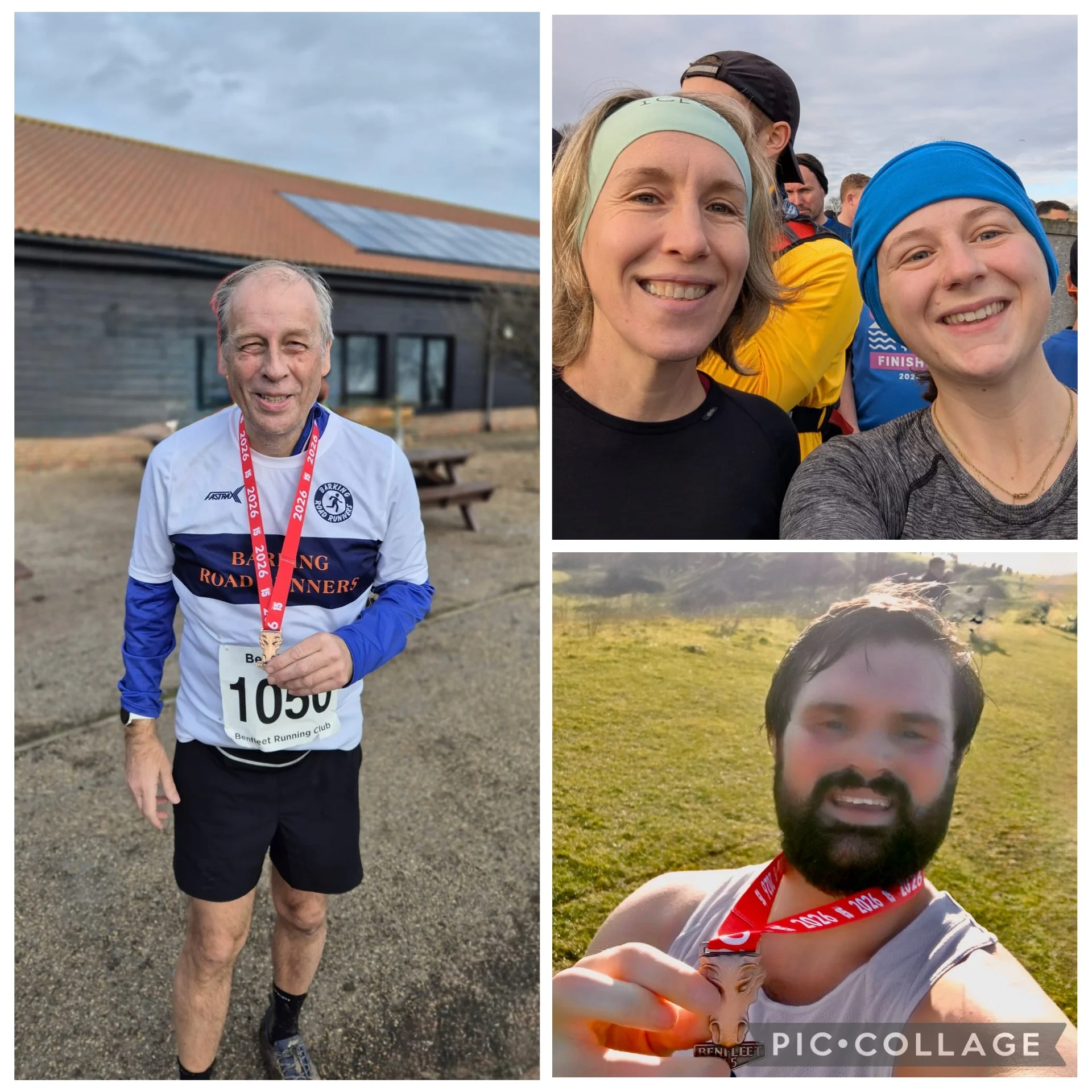
BRR’s Benfleet 15 runners
BRR parkrunners
Barking - Owen Wainhouse 21:54, Dominic Herring 24:21, Joshua Ezissi 25:08, Chris Muthaka 25:41, Faye Spooner 28:48, Jason Li 29:28, Martin Mason 32:47, Nikki Cranmer 39:01, Astrid Effendi 40:18 and Alan Murphy 56:12.
Basildon - Ron Vialls 30:14.
Chelmsford Central - Gary Harford 30:16.

Gary H at Chelmsford Central parkrun
Ferry Meadows - Sunny Bulchandani 24:10.
Ingrebourne Hill - John Mitchell 32:06.
Morden - Chandru Thayalan 31:42.
Queens Belfast - Belinda Riches 28:33, Rob Courtier 36:19, Dennis Spencer Perkins 36:52, Steve Colloff 37:32, Darren Graham 41:10 and Denise Graham 54:51.
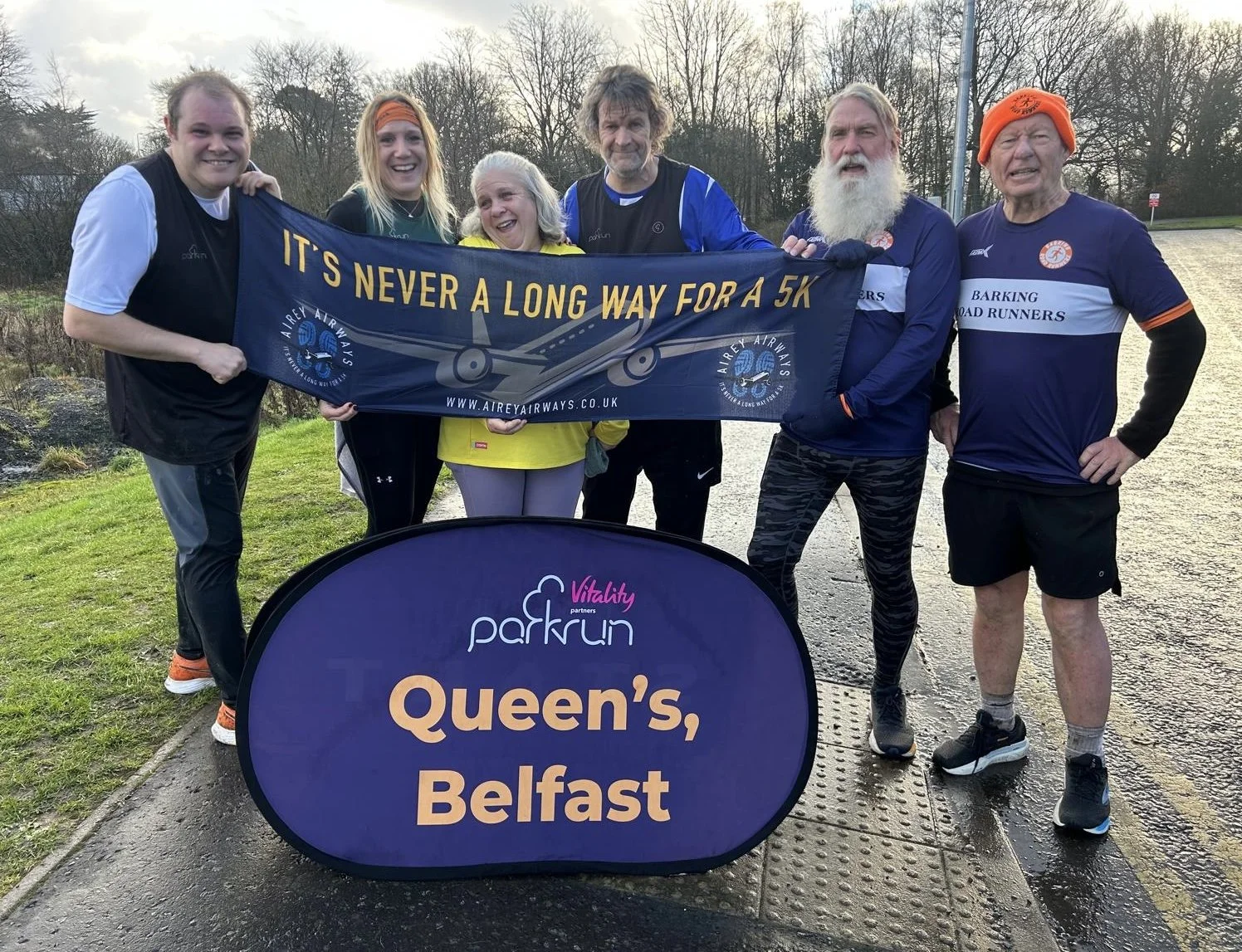
Darren, Belinda, Denise, Steve, Dennis and Rob at Queen’s Belfast parkrun
Valentines - Kevin Wotton 24:56.
Wimpole Estate - Martin Brooks 31:27.
Highest BRR age gradings this week were Belinda Riches 61.76% for the women and Owen Wainhouse 64.23% for the men.
BRR Diary - January/February
The highlights of the coming weeks are listed below but you can see the full diary of BRR events on the TeamUp app. Simply download the TeamUp app to your phone, then enter the calendar key: ks67p21gt8p5gzdo66 when prompted. If you don’t want another app on your phone, you can also find it under the ‘events’ tab on the Barking Road Runners website: https://www.barkingroadrunners.org.uk/calendar.
7.00pm, Tuesday 20 January - speed session. Jim Peters Stadium, Mayesbrook Park. I will be taking the session this week, and I thought I would build on Zahra’s matched pairs Toblerone session last week, with a Toblerone of my own. The good news: the reps are shorter. The bad news: the recovery is shorter too! The ‘Alison is kind really’ news: you get an extra minute recovery at the end of each block.
Three blocks of:
30 secs fast, 30 secs recovery
1 min fast, 30 secs recovery
90 secs fast, 30 secs recovery
2 mins fast, 30 secs recovery
90 secs fast, 30 secs recovery
1 min fast, 30 secs recovery
30 secs fast, 90 secs recovery
7.00pm, Thursday 22 January - Road Run. Castle Green Centre, Gale Street, Dagenham. A social run around the roads of Barking and Dagenham, usually around four miles. Faster runners loop back for those who aren’t so quick, so nobody gets left behind.
Saturday 24 January - Friday 30 January - Virtual Winter Handicap 02.
10.00am, Sunday 25 January - SECCL 04. Nuclear Wild Forest Obstacle Activity Centre, Parsonage Farm, Kelvedon Hatch, Brentwood, Essex, CM15 0LA. Fourth race in the South Essex Cross Country League competition, organised by Nuclear Striders. Expect one or two water features if it has been wet. Entry is normally £5 but BRR members pay only £3. As for the last couple of years, we are expected to sign a disclaimer before racing. Then back for…
2.00pm, Sunday 25 January - Barking versus the Builders football match. Football pitch by Barking Bus Garage, South Park Drive. The honour of BRR is at stake - can we beat the builders this time?
11.00am, Wednesday 28 January - Ron’s 5k Run. Barking Park.
11.00am, Saturday 31 January - Chingford League 06. Victoria Park Harriers Club House, St. Augustine’s Hall. Cadogan Terrace, London E9 5EG. A five-mile run around the tarmac paths of Victoria Park.
10.00am, Sunday 1 February - SECCL 05, One Tree Hill. Corringham, Horndon on the Hill, Stanford-Le-Hope, SS17 9NH. Last race in the 2025-26 South Essex cross-country competition.
Saturday 7 February - Friday 13 February - Virtual Winter Handicap 03. I’m not superstitious but I might not leave it until Friday the 13th to do my run, just in case.
Saturday 21 February - Friday 27 February - Virtual Winter Handicap 04.
Cracker Corner
I went to Ilford Exchange and a sign said ‘dogs must be carried on the escalator’. I spent hours looking for a dog.
Chris went out and bought a pack of graph paper. I think he’s plotting something.
My manager told me to have a good day. So I didn't go into work.
Quote of the week
"You don't always see it, but the effort you put in every day really does make a difference, and it matters."
James Clear
Author and Habit Expert
And Finally…
Did you know there is a ‘24 parkruns in 24 Hours’ challenge? Before you get excited, sorry folks, the challenge takes place in Australia, not the UK, and is unofficial so you can’t tot up 24 parkrun credits in as many hours.
Starting in 2017 in Perth, Australia, as a “crazy idea between mates”, a small group of runners set out to complete 16 parkruns in a day. But, with parkrun’s rapid growth, the challenge soon expanded; participants attempt 24 parkruns, totalling 120 kilometres, in a single day. It is described as a “fatass” event: self-supported, unsanctioned, and intentionally informal. Runners rely on spreadsheets, suggested timetables, and volunteer hosts, managing their own transport, food, and safety.
The event’s driving purpose is charity. Each participating state selects a cause meaningful to its local running community, with runners encouraged to donate a suggested fee of $24, whether completing one parkrun or all 24.
The atmosphere is a blend of exhaustion and inspiration, as participants battle fatigue, navigate between parks, and share in the triumphs and struggles of the day. Some aim for the full 24; some skip a few if they get behind schedule; many join for shorter stretches, all are welcomed by organisers.
We used to do something similar covering parkruns in East London, but it stopped for some reason (I’m not sure why). We never had the charity element, though. Is anyone crazy enough to start it again? Probably…